
|
|
|
|
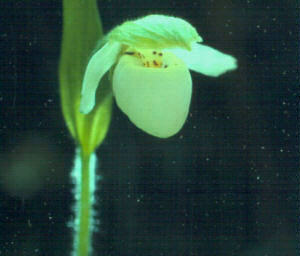
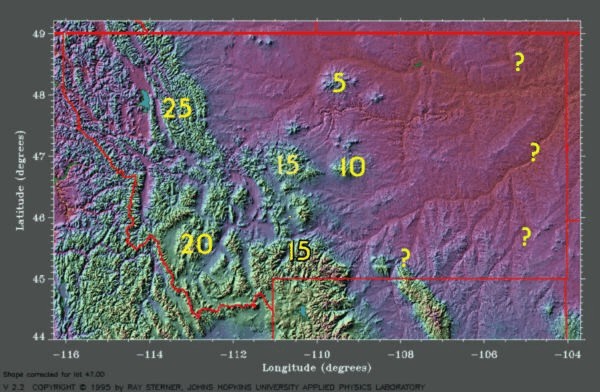
Cypripedium passerinum, the sparrow's egg orchid, may reach its southern-most limit in the Montana Rocky Mountains. Many people associate orchids with the tropics, and consider that if they were to be found at all in cooler climates, they would be only found in greenhouses or under cultivation. That isn't the case, the orchids are probably the most diverse and species-rich group of the flower plants, and they are found in virtually every habitat where other flowers grow. Montana is home to about 30 to 35 native, and one exotic, species of orchids. While some of these are, without a doubt, the most unprepossessing of wild flowers, a few others at the other end of the spectrum are truly spectacular and really give new meaning to the "wild" in wild flowers. Images of most species may be found by following the "species" link at the bottom of the page. All orchids have symbiotic relationships with fungi. Probably because of this, virtually NONE of Montana's native orchids will survive transplanting. If you search for wild orchids, leave them in the wild. Do not kill them by attempting to transplant them. Orchids are not distributed evenly throughout the state, with most species found in the montane western part of the state. Virtually no species have been reported from the prairies of Eastern Montana, but I think this may be simply an artifact of insufficient searching. An old truism about science is that "you can only find what you are looking for," and I really don't think many botanical surveys have examined the eastern part of the state looking for either wild flowers, or particularly orchids. For the last 8 years I have been embarked on crusade to photograph all of the Montana orchids in their natural settings, as part of what will, I hope develop into a book on these wonderful flowers. As far as the orchids are concerned Montana may be divided into four regions.
A map of Montana showing the approximate number of orchids in each area. Map used by permission of the copyright holder, Dr. Ray Sterner, Johns Hopkins University, Applied Physics Laboratory.
There are some defined groups of orchids found in Montana and elsewhere. First, there are the lady slippers, represented in Montana by four species of Cypripedium. Then there are dry forest orchids, represented by the Coral Root Orchids (Corallorhiza, 5 species), the fairly slipper (Calypso bulbosa), the Rattlesnake Plantains (Goodyera, 2 species), four species of twayblades, (Listera species) and a few of the rein orchids, (Piperia, and Platanthera). The bog orchids are well represented by and (Amerorchis, Epipactis, Piperia, Platanthera, Coeloglossum, Liparis, Listera, Spiranthes) about 15 species). In a few areas, a couple of orchid species in this region may be called stream orchids. These are in the genus Listera and Epipactis. Although all of these flowers may be locally abundant, some of them are decidedly rare in the state as a whole. A few of them are uncommon, due to habitat loss caused mainly by cattle grazing or inappropriate farming practices, development for housing, urban sprawl, or direct harvesting by humans. A couple of species buck this trend and are very common, almost to the point of being weeds, Platanthera dilatata and P. hyperborea fall into this category. These species may often be found growing in barrow pits or other disturbed areas. One orchid found mostly in disturbed areas is the Ute orchid, Spiranthes diluvialis. Recently found in the state, and considered very rare, it is small unobtrusive plant that I think will turn out to be surprisingly common. I am always on the look out for new locality information, if you find something of interest, please contact me. This page was last updated on 17 March, 2002 06:46:02 PM
|
|
|