|
|
|
|
Unless otherwise noted, the illustrations posted here are copyright by the named source and used with permission. Reuse of these photos without the consent of the photographer constitutes a violation of the copyright and is illegal.
This page was last updated on 16 December, 2004 08:15:01 AM
Contributed by Michael Wamsley, this fleshy limpet was photographed in a reef aquarium. Fleshy limpets are keyhole limpets where the shell is totally covered by the soft tissues of the animal. They may be any number of colors, but tend to be some shade of orange, tan, or beige. The nipple-like aperture on the top of the expanded fleshy mantle is distinctive. They are small, typically no more than an inch or two (up to 5 cm) in length. Like all keyhole limpets they do have a good shell, and an even better rasping organ. Their diets are not adequately known, but they probably will eat either calcareous algae or sessile invertebrates.
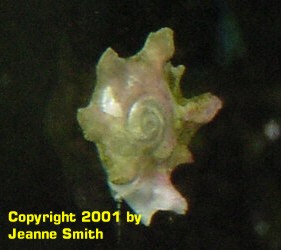
This xenophrid is shown from the bottom, and aperture of the shell is pointed down. This animal was less than 2.5 cm (or 1 inch) across. Carrier shells, or Xenophrids, are snails that cement other shells or pieces of rubble to their shells. These "carried" shells often are so large that the snail cannot crawl, and so moves by making short jumps with its muscular foot. They are uncommon in aquaria, but have been reported to me two or three times. Their natural history is poorly known, but they may be mostly sediment feeders. Alternatively, they may eat sediment infaunal worms.
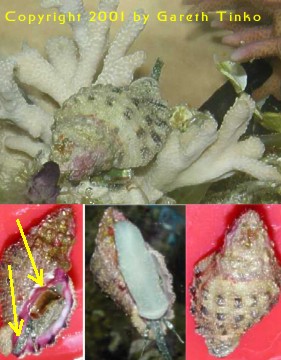
Coral eating snails are common on coral reefs. These are whelks in the Family Coralliophilidae. This name means "coral loving" - and they certainly do love corals. They love to eat them. This is actually a rather large group of snails, contain several dozen species. They are characterized by the purple or dark pink aperture, and the constricted siphonal canal at the front of the shell.
This composite illustration contains photos contributed by Gareth Tinko. I have tentatively identified this animal as belonging to the species Coralliophilia fearnleyi. This species is common throghout the Indo-Pacific and likely entered the hobbyist's tank by hitchhiking in on live rock. The upper image shows the snail feeding on a coral in the aquarium. The arrows in the lower left image show the the constricted siphonal canal and the colored aperture. The image in the center shows the animal crawling on the aquarium wall. The lower right image shows the shape and a characteristic shell color pattern. Many of the coral-eating snails look very similar to this.
Contributed by Danny Shurett, this photo shows two parasitic snails on the sea star. This particular snail, Thyca crystallina, is a specialist parasite that lives on sea stars in the genus Linckia. Here two individuals are on a Linkia laevigata. Generally found in female/male pairs, they cut holes through the body wall and suck the star's internal fluids. The snail is member of a large group of snails called the Eulimidae, most of which parasitize echinoderms such as sea cucumbers, sea urchins, or sea stars. Other, more benign, ectoparasitic crustaceans may be found on some stars.
Nudibranchs that prey on soft corals have been reported with some frequency. Most of these are dendronotaceans and most appear to be in the genus Tritonia. Species in this group of nudibranchs seem to specialize largely in soft corals or sea anemones.
The left and center pictures are almost a classic Tritonia with relatively few frills while the right image possibly of Tritoniopsis eating a Cladiella shows a more typical tropical species.
This trochid snail is infested with pyramidellid parasites, about 20 are visible on it.
|
|
|