|
|
|
|
Unless otherwise noted, the illustrations posted here are copyright by the named source and used with permission. Reuse of these photos without the consent of the photographer constitutes a violation of the copyright and is illegal.
This page was last updated on 16 December, 2004 08:15:10 AM
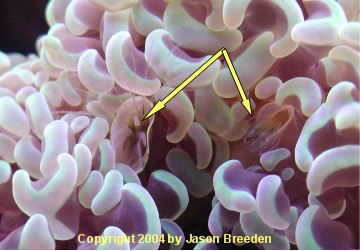
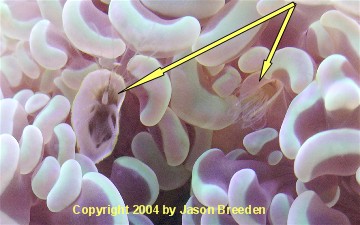
These small barnacles, called "pyrgomatid barnacles," settle out of the plankton as larvae and undergo a metamorphosis where they bore through the coral tissue to the skeleton of scleractinian corals. They form a blister-like cyst which the living coral tissue overgrows and covers. The barnacle is not parasitic on the coral and feeds by catching planktonic food with its modified feet. These animals generally do not persist in reef aquaria as there is generally not sufficient food. After they die, the coral overgrows the cyst.
These two photos, courtesy of Jason Breeden, show two pyrgomatids living on a Euphyllia.
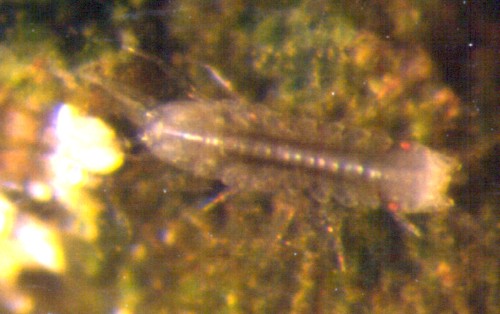
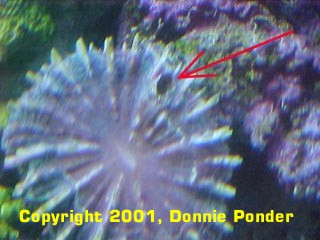
Small amphipods in the family Stenothoidae are common commensal animals living on cnidarians in all seas. Recently they have been seen on corals in aquaria, and some were sent to me for identification. These very small amphipods likely live by eating coral mucus and maybe any adherent material in it. They do not appear to harm the corals.
This photo shows two small, but fully mature amphipods near a single Acropora polyp. The red portion is the abdomen. A bright eye is also visible.
Isopods Because of the predatory and aggressive nature of cirolanid isopods in reef aquaria isopods, in general have become a matter of some concern to many aquarists. Cirolanids can kill fish and will even attack and suck the blood of aquarists. Nonetheless, most isopods found in marine aquaria are harmless. Here are some images of several types of isopods to assist you in determining which kind you might have in your tank. Some of the nastiest animals that may find their way into a reef tank are cirolanid isopods. These are parasites/predators on marine fish, and occasionally on aquarists.
These are images of cirolanids found in reef aquaria. The animal on the right was feasting on the aquarist when removed from the tank. The red in it is human blood. Follow the link in the header for more information about cirolanids. For more information on isopods in general and some ways to distinguish the good guys from these nasty ones, see this article.
Sphaeromatid Isopods Sphaeromatids are small, sediment-dwelling scavengers or detritivores; see this article for ways to tell them from the nasty cirolanids. The easiest way to distinguish them are indicated in the image below.
The upper image is of a sphaeromatid isopod, the lower one a cirolanid. The distinguishing characteristics are indicated.
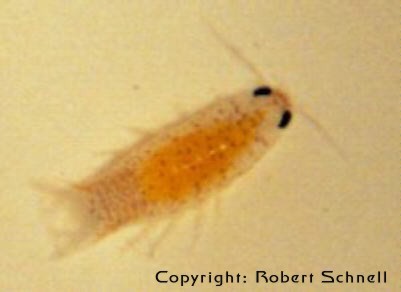
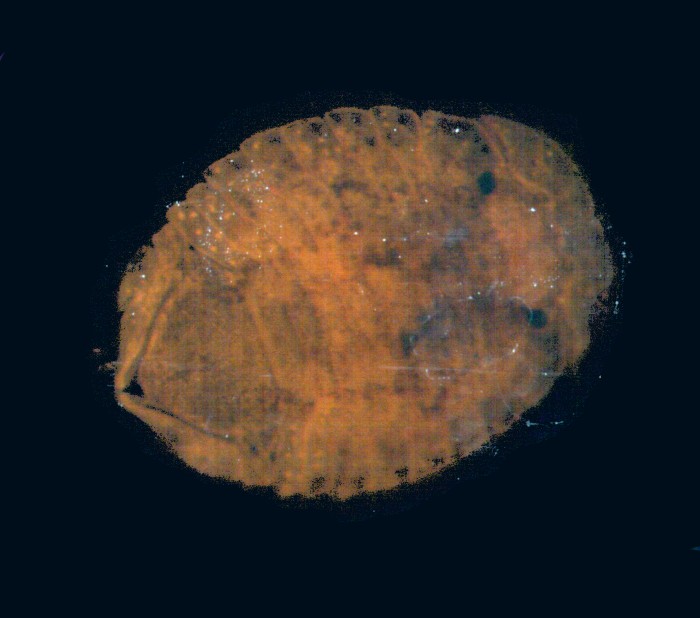
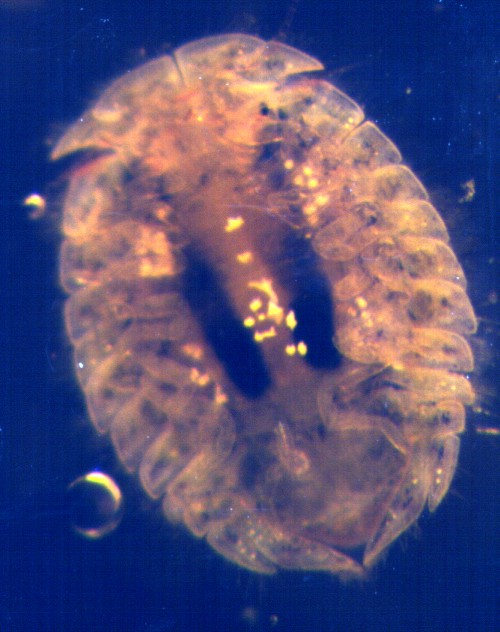
The left image is from above the animal. The small eyes are visible at the back of the head. The right image is from the bottom, and with careful examination the legs will be seen. Sand skaters are small isopods, generally less than a couple of millimeters long that scoot rapidly over the surface of sand. They are camouflaged by their coloration and are quite hard to see. Unlike Cirolanid or other predatory isopods, these are harmless sediment or detritus feeders. They are taxonomically placed in the Isopod Family Seriolinidae. They are not common in reef aquaria but have been seen in a few of them. For more information about isopods, in general, as well as ways to tell them apart, see this article.
The legs of Munnids extend laterally on both sides of the animal at least the width of the body. They can move quite rapidly, if need be, but often are seen creeping slowly over the substrate. Munnid isopods are another harmless group of isopods found in marine aquaria and, of course, elsewhere. They are small, generally less than 5 mm (1/5 in) long, and often have long spidery legs. their eyes are evident, but not enlarged as are those of the predatory Cirolanids. Munnids are thought to be exclusively herbivorous. As their name implies, they are found in the Isopod Family Munnidae. For more information about isopods, in general, as well as ways to tell them apart, see this article.
Coral Parasite = Gall Crab Since the beginning of 2001, I have had five people notify me about a parasitic arthropod that is found in several species of stony corals. One of the readers of my forum, Mr. Ken K. Uy, suggested that this was a gall crab, in the group called the cryptochirids, and upon examination of several references I concur that this is almost certainly correct. I haven't got a specimen of the crab to examine, so I cannot identify the crab with certainty. Specimens has been reported reported in elegance corals (Catalaphyllia jardinei), as well as Favia, and Scolymia. I have not been able to identify this animal beyond the general classification of "shrimp." They apparently live in the skeleton of the coral and may displace the coral from the skeleton. They also may be eating the coral. If you find one in your coral, and it appears to be causing damage, you probably should try to remove it, if it is possible to do so without damaging the coral.
he two left images were contributed by Robert McGee, who first brought this animal to my attention. In the image to the left, the flattened top of the shrimp's head region is indicated. The right image of a crab molt was contributed by Jim Whitney. The left image was contributed by Donnie Ponder, who noticed the same type of parasite in the Scolymia. The centert image is by Jim Roth and the right image is by Jim Whitney. The crabs (mislabeled by me as a "shrimp") are visible.
The left image shows dorsal and ventral views (lower and upper view) of the copepods. The right image shows a female with one egg mass (normally they have two, but one was knocked off in transit to me. These are small bugs, less than a millimeter across that live on sea stars. These were reported from a Linckia shipped into the United States from Tonga. They live on the surface of the star, and I would guess (but don't know definitively) that they also enter the gut and may graze on the star's food. They probably are ectoparasites, but may be commensals. They probably don't appreciably harm their host.
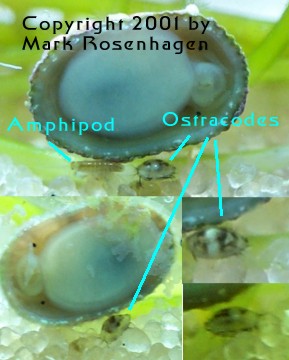
Several species of tiny seed shrimps or ostracodes, (often incorrectly referred to as "ostracods" ) are commonly found in aquaria. They tend to be detritus-feeding or bacterial grazers living in the sediments. They have a clam-like shell, but are true crustaceans and move by the action of their small legs which extend out of the shell. They seldom get much beyond a millimeter (1/25th inch) long, and many of them are smaller than that. They are harmless, or beneficial. They are eaten by many "nipping" fishes such as Mandarin dragonets.
This image, contributed by Mark Rosenhagen, shows several ostracodes in the sediments around a limpet. Note the visible appendages and the general ovoid shape.
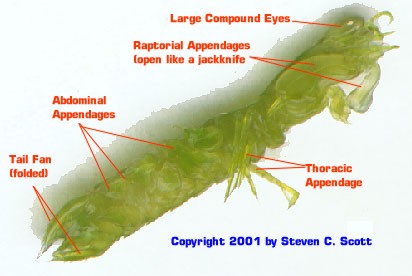
Mantis Shrimps = Stomatopod Crustaceans These are sometimes considered to be THE bane of reef aquarists, although I would argue that there are several more seriously dangerous animals shown on this page. Mantis shrimps are, compared to Cirolanid isopods for example, easy to remove and deal with. There are many mantis shrimps which may potentially be found in our systems, but relatively few actually seem to show up. There seems to be a continual question as to what they really look like, and the illustration shown here should help anybody who doesn't know the animals' appearance to be able to identify them. However, do NOT use the color as an important character, stomatopods come in many colors and they may change there colors as well. DO use the basic shape and structures to help in their identification.
Some of the diagnostic characters are indicated in the above photo. They have an outsized or large abdomen with a large and evident tail fan. The thorax is short and covered with a shield-like carapace or shell. The eyes are large, on stalks and exceptionally well-developed. The raptorial or prey capture appendages are held under the body, rather as in a preying mantis, until the animal is ready to strike. Then they are used with deadly accuracy. The force of the appendage impact in some mantis shrimps is about equivalent to a .22 caliber bullet and is sufficient to break thick aquarium glass or bones in the hand of the aquarist. In other mantis shrimps the appendages are used to slice the prey rather than strike it. These mantis shrimps have the common names of "thumb-splitters" for good reason. Mantis shrimps should not be condemned out of hand. They may be the most intelligent of the marine arthropods, and make engaging pets when kept in a tank designed for them. They are very neat animals with interesting behavior - and they are exceptionally efficient predators.
|
|
|