|
|
|
|
Unless otherwise noted, the illustrations posted here are copyright by the named source and used with permission. Reuse of these photos without the consent of the photographer constitutes a violation of the copyright and is illegal.
This page was last updated on 19 December, 2004 05:33:34 PM
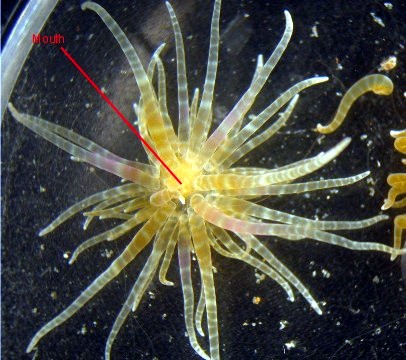
The anemones in the genus Aiptasia are common pests in aquaria, yet there are few good photos of them available for novices to examine to determine if they have such animals in there tank. The image below is of a characteristic Aiptasia, and should help most folks identify them.
Boloceroides
mcmurrichi The body is tan, or brown; tentacles relatively robust for a small species, may be banded, the disk may have whitish radial or blotchy markings. They reproduce asexually by producing asexual larvae or by pinching off small chunks of pedal disc tissue which then differentiate in to a small anemone. Both juveniles and adults are mobile, creep rapidly over the substrate or detach and float to a new spot. If disturbed, they will swim by the use of rhythmic contraction and flexion of the tentacles. Manual control by any of several methods (injection with toxic materials, or smothering) is possible if they are removed when the populations are small. As with Aiptasia, the most effective biological control is a Copperband Butterfly fish, Chelmon rostratus. Peppermint shrimp, Lysmata wurdemanni, may also be useful in some systems. Both of these predators may also eat other tank life.
Boloceroides mcmurrichi. Image Copyright 2004 by Ronald L. Shimek
Hydrozoan Jellyfish Dots With Legs - Staurocladia oahuensis - Tiny Hydroid Jellyfish That Walk Around Tanks
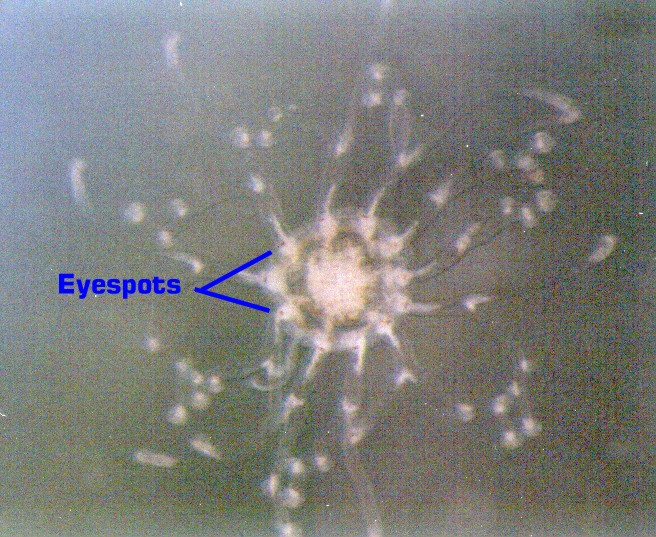
The image at the above left was contributed by Kathryn Metcalfe and taken with a digital camera from outside the tank. It shows what a dense population of them looks like from the outside of the aquarium.. The remaining images I took using a compound microscope, and various lighting arrangements. The animals are between one and two millimeters in diameter. These are organisms which are turning out to be relatively common. They are crawling hydroid jellyfishes, which do not swim, but rather move around the tank sort of like a small, soft, slow spider. They move by fastening on to the substrate with their adhesive patches. The tentacles are tipped with concentrations of nematocysts. There is a red eyespot at the base of each tentacle. These organisms become quite abundant in some reef systems, and then rapidly disappear without a trace. A Japanese researcher, Dr. Yayoi Hirano, provided the following information: "They are crawling hydromedusae,
in the species Staurocladia oahuensis.
There are about 15 species of this genus known in the world. All of them have
branched tentacles, and can adhere to substrata,
such as algae, by the
tentacles, with the surface with eyespots facing upward. The tip of the lower
branches are used for adhesion, and the upper branches have a few or more (depending
on species) nematocyst clusters. Arrangement of the nematocyst clusters is a key to identify species. They
reproduce asexually either by budding or fission, so under favorable conditions they often can become
abundant in aquariums. This species has been found in a fish farm and also
in a abalone aquaculture center in Japan. It seems the species has a high rate
of asexual reproduction under favorable conditions. Even one jellyfish
accidentally introduced in an aquarium may increase in a population of hundreds
within a few months if the conditions are really good. It is also very possible
that the polyp stage of the species lives on corals or rocks which may be
brought into the aquaria. The polyps may form a dense colony if it is
provided with much food. Within a short time the number of polyps may be
very large, and the polyps may produce many jellyfish. The jellyfish and
polyps will eat Artemia nauplii and copepods.
Dots with legs, Part 2. Cladonema jellyfish
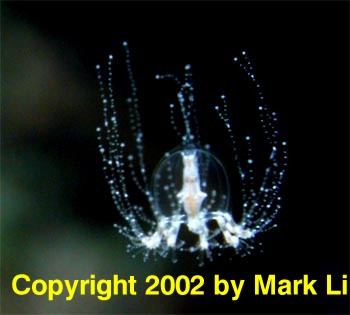
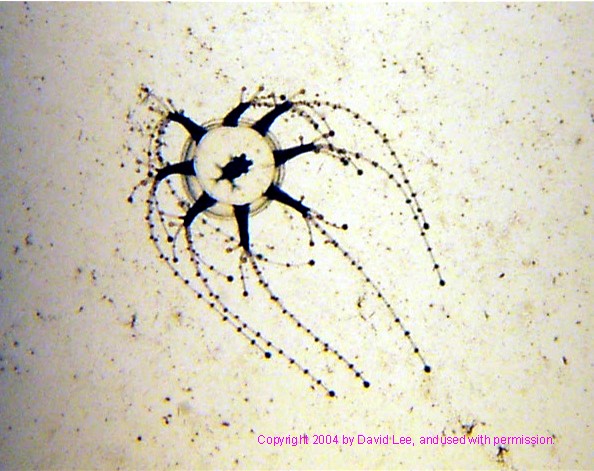
Three images, the left two courtesy of Mark Li, and the right one courtesy of David Lee, of individuals of Cladonema species in an aquarium. These are small
jellyfish that can swim, but which also fasten to the substrate. Unlike
the Staurocladia mentioned above, they don't crawl much. Not much
is known about their biology. In aquaria they probably feed on small
copepods and particulate material in the water. They may be distinguished from Staurocladia
by more developed globular bell, their slightly larger size, and the shape of the
tentacles.
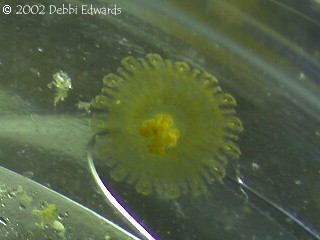
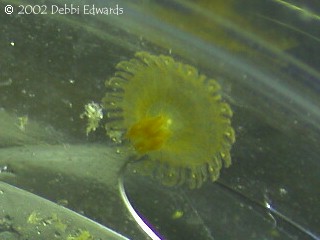
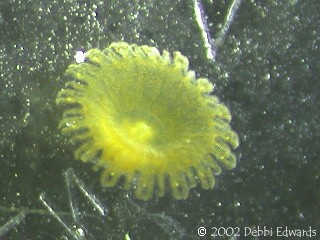
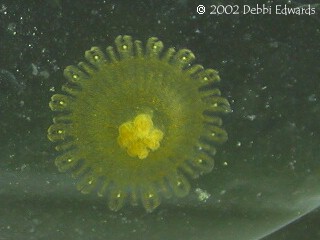
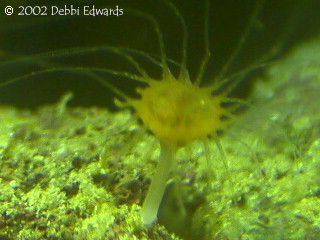
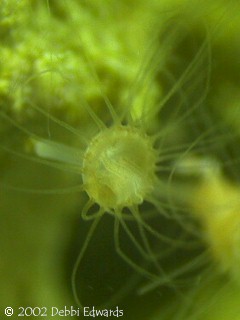
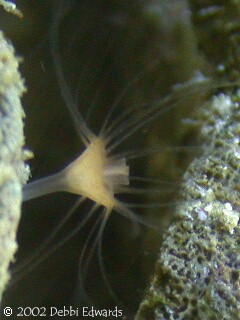
Scyphozoan Jellyfish, Part 1. This type of jellyfish is typically different in structure than the one described in the next section, below. It is quite complex, and many of these are rather beautiful in their complexity. The following seven images are courtesy of Debbi Edwards, and show a small, but quite complex type of jellyfish that was found in her tank. The upper four images are of the medusae, the lower three are of the polyps that budded them off.
These four images show medusae, in the right most image the small bright dots visible around the periphery of the animal are statocysts or "balance organs.
These three images show various views of the hydroid polyp that budded off the jellyfish above.
Here is some information about these animals, or some very similar to them, taken from a thread in the Ask Dr. Ron Forum. Please see the thread for more details. "These critters seem to be the entire polyp minus the stalk when they change into medusae.
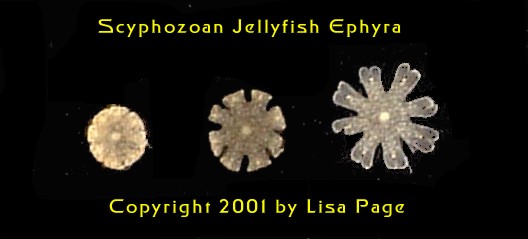
Scyphozoan Jellyfish, Part 2 Scyphozoan jellyfish, or medusa are often referred to as "true" jellyfish (which begs the question of "What is an untrue jellyfish?"). These are animals classified by biologists as belonging to that part of the Phylum Cnidaria referred to as the Class Scyphozoa. In this group, the dominant portion of the life cycle is a jellyfish, although polyps are found they are small and inconspicuous. Mature medusa are often large and presumably long-lived, but are typically budded from a small polyp, called a scyphistoma. The polyps may occasionally find their ways into marine reef aquaria on "live rock." They make their presence known by budding off the very small jellyfish which if given time, room, and food, would mature into the large adults.
These images, contributed by Lisa Page, show one small Scyphozoan jellyfish going through a swimming pulsation. These small jellyfish are quite distinctive and easily told from other types of jellyfish by their 8 "arms." As they grow the spaces between the "arms" fill in to form the typical scyphozoan medusoid shape with eight lobes. This growth is unlikely to occur in aquaria as it may take several months, and is generally occurs in the plankton. Although large public aquaria can raise these medusa, due to the lack of necessary and specialized tanks, it is essentially impossible to for hobbyists to keep these animals alive long enough for this to happen.
Digitate or Finger-Like Hydroids
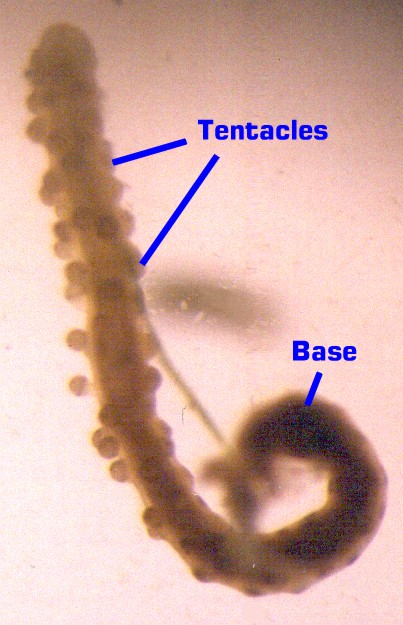
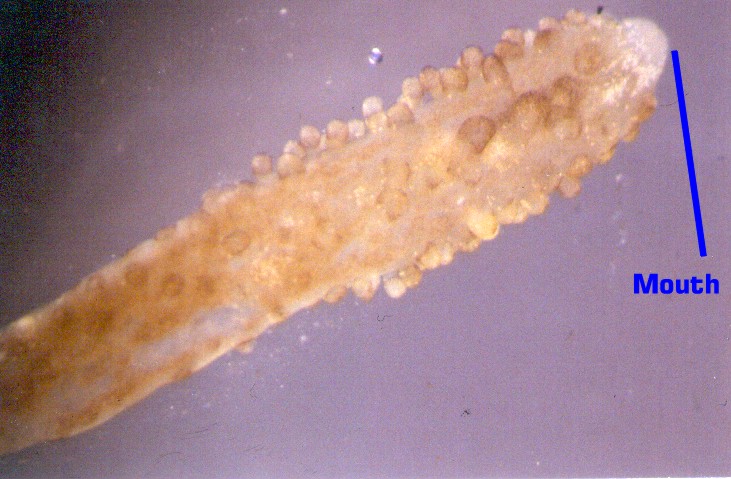
The finger hydroid, probably some individuals of a Myriothele sp. The tentacles may extend out a long distance from the body, as shown in the aquarium view on the right. These animals were about 3 or 4 mm long (about an 1/8th of an inch) contracted, but may be almost an inch long when fully extended.. These animals are among the more weird animals in a group that has a lot of weird species in it. They are individual hydroid animals, but the polyp is highly modified to be cylindrical in shape with the mouth at the upper end. The base fastens to the substrate with special modified tentacles and the body extends up into the water. In one aquarium, at least, the tentacles extend after dark and are relatively long. These hydroids are definitely aggressive and are quite capable of "burning" or stinging other aquarium animals.
These are really very abundant animals in nature, and on occasion in our reef tanks. Some hydrozoans have quite the potential to become pests, but others simply add to the diversity of our systems. As all of them can sting, they have the capability to attack other other animals, and many have the potential of being quite a nuisance to the aquarist if they get brushed against. Others are harmless. Many of these polyps are quite beautiful in their morphology. A discussion of their natural history and biology, along with numerous images is found in this article.
These images, courtesy of John Mas, show a small white hydroid that spreads by horizontal runners or stolons, much like a colony of star polyps or strawberries. The individual polyps are indicated by yellow arrows.
The image to the left is looking directly down toward one individual in the colony. Note the many thread-like and unbranched tentacles. The center image shows a portion of the colony with several individuals. The right image is a side view. Note the protective outer proteinaceous sheath does not or enclose the feeding polyp. As the name implies these are more normally looking hydroids than are the digitate hydroids sometimes found in aquaria. They are not any less the pests for that, however, as they are tenacious and quite capable of overgrowing corals, soft corals, and other decorative sessile fauna. They are quite capable of giving a serious sting as well, to sensitive individuals. They are suspension-feeders and will do well in a well-fed aquaria. The individual polyps are small about 1/10 in (2 mm) across. Each polyp is surrounded by what has been referred to as a tubular chitinous sheath, but in reality, it is likely of proteinaceous origin. If the colony starts to become a problem, it may often be simply "peeled" off the the rock. Otherwise, they may be killed with a calcium-hydroxide paste. Several species names have been used for these animals in the hobby "literature," but I am not sure any of them are correct, so have not included any here. Compare these with some other more delicate, more attractive and less offensive hydroids.
|
|
|